I came across an interesting op-ed written by an Austin blogger, someone I link to from here because he's very involved in seeing that our criminal justice system improves. Annoyingly, he also likes to hold cops and prosecutors accountable for their actions, an outrageous position that no right-minded human would go along with. And I disagree with him on some issues.
But this is written not just from his perspective as a criminal justice observer, so to speak, but as a resident of the relevant part of Austin. And if you're not from Austin, you should check it out anyway because I'm betting there's a part of your city where drugs are exchanged in plain sight, and where cops spend a lot of time arresting dealers and buyers.
It's also interesting to me because he's talking about the "Charlie" sector of Austin, where I roam every Thursday night with the Austin Police Department. I pass through the corner he talks about, 12th and Chicon, two or three times an evening and, well, it ain't nothin' like my neighborhood.
His solution, in sum, is to tone down the arrests and do something "for the children." Specifically, help those kids whose parents are in prison. Not an original thought, as I'm sure he'd acknowledge, but I get to see that side of it, too, working down at the juvenile courts. And picking a number out of the air, without thinking about it too hard, I'd say 90 percent or more of the kids I see have no father-figure in their lives. I don't know how many are in prison but I'm betting a few. A kid was crying in court today, arrested for assaulting someone, and he was telling the court his dad was doing life somewhere for something. "You want to be like that, too?" the judge asked him.
He said, of course, "No," but it doesn't look good for him.
Monday, July 23, 2012


Thursday, July 19, 2012
Of Dope and Discretion
Two quick things before I head out to my Thursday night ride-along.
First, a riddle: two men are consuming marijuana when a policeman walks into the room. The man smoking the joint is arrested and charged with a misdemeanor, but the man eating it is charged with a felony. Why?
(I'll post my answer - hey, there may be more than one correct answer, right? - over the weekend, but it has nothing to do with amounts or weights.)
Second, a quick shout out to a fellow prosecutor (former) writing novels. Her second has just been released and is getting great reviews. So if you're on the look-out for more summer reading, check out her book. It's been described as a legal thriller exploring the intersection of sex and power in D.C.’s most secretive worlds. Pretty timely, eh? (Click here to zip over to her web site.) I think her publisher is sending me a copy to review so I'll wait to say more.

First, a riddle: two men are consuming marijuana when a policeman walks into the room. The man smoking the joint is arrested and charged with a misdemeanor, but the man eating it is charged with a felony. Why?
(I'll post my answer - hey, there may be more than one correct answer, right? - over the weekend, but it has nothing to do with amounts or weights.)
Second, a quick shout out to a fellow prosecutor (former) writing novels. Her second has just been released and is getting great reviews. So if you're on the look-out for more summer reading, check out her book. It's been described as a legal thriller exploring the intersection of sex and power in D.C.’s most secretive worlds. Pretty timely, eh? (Click here to zip over to her web site.) I think her publisher is sending me a copy to review so I'll wait to say more.
Monday, July 16, 2012
Ballistics - matching bullets
Last week I showed you the brilliant photos that Greg Karim and his
colleagues use to figure out whether a cartridge casing was fired from a
particular gun. As promised, today I'm posting a series of photos
that show how the same kind of examination is made on the bullets
themselves.
Remember, here's the situation:
A bullet is removed from the body of a victim. It's placed into evidence and locked away. A gun is found on a suspect, who's now a hundred miles from the crime scene. The gun is also placed into evidence and locked away.
The essential question this time is: was the bullet from the victim fired from this gun? If so, that's some good evidence. If not, we need to know that too, so we can find the right murder weapon.
So, APD firearms guru Greg Karin retrieves the bullet and the gun from the evidence locker and retreats to his lab.As before , he fires the weapon into a barrel of water. He'll do a number of test fires, fifteen for example. Then he will put the bullet from the victim under a microscope, examine it, and take close-up photos. He will do the same with the test-fired bullets.
This is what he'll see:


Now, you'll see reference on these photos to two types of characteristics: class and individual. The examiner is looking to make matches in both classes, and here's their basic definitions:
Class characteristics can be defined as:
Where individual characteristics are:


Remember, here's the situation:
A bullet is removed from the body of a victim. It's placed into evidence and locked away. A gun is found on a suspect, who's now a hundred miles from the crime scene. The gun is also placed into evidence and locked away.
The essential question this time is: was the bullet from the victim fired from this gun? If so, that's some good evidence. If not, we need to know that too, so we can find the right murder weapon.
So, APD firearms guru Greg Karin retrieves the bullet and the gun from the evidence locker and retreats to his lab.As before , he fires the weapon into a barrel of water. He'll do a number of test fires, fifteen for example. Then he will put the bullet from the victim under a microscope, examine it, and take close-up photos. He will do the same with the test-fired bullets.
This is what he'll see:


Now, you'll see reference on these photos to two types of characteristics: class and individual. The examiner is looking to make matches in both classes, and here's their basic definitions:
Class characteristics can be defined as:
Intentional or design characteristics that would be common to a particular group or family of items.
The class characteristics of firearms that relate to the bullets fired from them includes the caliber of the firearm and the rifling pattern contained in the barrel of the firearm.
Where individual characteristics are:
marks produced by the random imperfections or irregularities of tool surfaces. These random imperfections or irregularities are produced incidental to manufacture and/or caused by use, corrosion, or damage. They are unique to that tool and distinguish it from all other tools.


Wednesday, July 11, 2012
Ballistics - matching casings
One of the coolest aspects of this job is getting to work with people who are masters in their field. Of course, given my job their field is inherently interesting so you can imagine how fun it is to work with, say, a top-notch firearms analyst.
You know, like Austin P.D.'s Greg Karim.
Two of the things Greg and his colleagues can do include tests to (1) determine whether or not a particular shell casing was fired in a particular gun; and (2) whether or not a particular bullet was fired from a particular gun.
I want to do two posts on this, one for each. You'll see why, below. First the casings, and we should be sure of terminology. Here are the terms we use:
Cartridge -- what you pull from the box of ammo you buy at Wal-Mart, and load into your gun.
Bullet -- the piece of lead that is expelled from the barrel of the gun when you shoot.
Casing -- the container for the propellant and bullet, which is left empty after use and either expelled from the gun (via ejector) or remains in the cylinder.
Here's how he works: a spent casing is found near the body of our imaginary victim. It's placed into evidence and locked away. A gun is found on a suspect, who's now a hundred miles from the crime scene. It is also placed into evidence and locked away.
The essential question is: was the casing found near the victim fired in this gun? If so, that's some good evidence. If not, we need to know that too, so we can find the right murder weapon.
So, Greg retrieves the casing and the gun from the evidence locker and retreats to his lab. There, he fires the weapon into a barrel of water, using identical ammunition to the found casing. He'll do a number of test fires, fifteen for example. Then he will put the casing from the crime scene under a microscope, examine it, and take close-up photos. He will do the same with the test-fired casing. I am simplifying, and he'd pull his hair out at such a poor summary of his laborious, time-intensive work, but this is essentially the process by which he can say whether or not the casing from near the body was fired from the gun found on the suspect.
What he's looking for are areas on the two casings that bear the same marks, showing that when you fire this type of ammo from this gun, you'll get this mark. The marks can come from the casing expanding inside the barrel (when it gets hot) and essentially being 'printed' with the marks in the barrel, and the marks can come from the firing mechanics themselves.
You know what? Best if I show you . . .

Pretty neat, huh? As you've probably figured out, these photos show the hypothetical casing from the crime scene (left) and the test-fire (right). They sure look like a match, but can we do better? Can we be more certain? Why yes, since you ask, we can. . .

The tiny black line down the center is where the subject casing and the test-fired casing meet. This is the photo that always impresses jurors (and me!) because you can see for yourself how the two match up.
Here are some more from other casing analyses (credit where it's due, these photos were actually taken by Erica Pusch, Greg's colleague at APD).


 And coming up soon, images like this of the bullets themselves. Pretty neat, don't you think?
You know, like Austin P.D.'s Greg Karim.
Two of the things Greg and his colleagues can do include tests to (1) determine whether or not a particular shell casing was fired in a particular gun; and (2) whether or not a particular bullet was fired from a particular gun.
I want to do two posts on this, one for each. You'll see why, below. First the casings, and we should be sure of terminology. Here are the terms we use:
Cartridge -- what you pull from the box of ammo you buy at Wal-Mart, and load into your gun.
Bullet -- the piece of lead that is expelled from the barrel of the gun when you shoot.
Casing -- the container for the propellant and bullet, which is left empty after use and either expelled from the gun (via ejector) or remains in the cylinder.
Here's how he works: a spent casing is found near the body of our imaginary victim. It's placed into evidence and locked away. A gun is found on a suspect, who's now a hundred miles from the crime scene. It is also placed into evidence and locked away.
The essential question is: was the casing found near the victim fired in this gun? If so, that's some good evidence. If not, we need to know that too, so we can find the right murder weapon.
So, Greg retrieves the casing and the gun from the evidence locker and retreats to his lab. There, he fires the weapon into a barrel of water, using identical ammunition to the found casing. He'll do a number of test fires, fifteen for example. Then he will put the casing from the crime scene under a microscope, examine it, and take close-up photos. He will do the same with the test-fired casing. I am simplifying, and he'd pull his hair out at such a poor summary of his laborious, time-intensive work, but this is essentially the process by which he can say whether or not the casing from near the body was fired from the gun found on the suspect.
What he's looking for are areas on the two casings that bear the same marks, showing that when you fire this type of ammo from this gun, you'll get this mark. The marks can come from the casing expanding inside the barrel (when it gets hot) and essentially being 'printed' with the marks in the barrel, and the marks can come from the firing mechanics themselves.
You know what? Best if I show you . . .

Pretty neat, huh? As you've probably figured out, these photos show the hypothetical casing from the crime scene (left) and the test-fire (right). They sure look like a match, but can we do better? Can we be more certain? Why yes, since you ask, we can. . .

The tiny black line down the center is where the subject casing and the test-fired casing meet. This is the photo that always impresses jurors (and me!) because you can see for yourself how the two match up.
Here are some more from other casing analyses (credit where it's due, these photos were actually taken by Erica Pusch, Greg's colleague at APD).


 And coming up soon, images like this of the bullets themselves. Pretty neat, don't you think?
Monday, July 9, 2012
Nerves, for the first time in years
I don't get nervous. I don't get rattled, either. When that idiot/not idiot intentionally crashed into us, then rammed his car into a building, I felt cool as a cucumber the entire time. Didn't get the adrenaline rush I'd been expecting, nor any swings in emotion. Likewise, I can get up and speak to a bunch of strangers in court with no hint of nerves, just a vague tingle of excitement. Basically, cucumber.
And no, I'm not a sociopath (while scary things don't bug me, I can't watch Schindler's List-type movies for fear of blubbing like a baby).
Today, however, I was paralyzed with fear. There I was, at the collision center turning over my vehicle for repair after the above-mentioned accident, when I was confronted by something I knew I'd one day have to face.
A review.
Yes, a professional reviewer had read and passed judgment on my book. My publisher forward a link to the review in an email but I couldn't bring myself to read it. Publishers Weekly is the organ, and whoever wrote the review doesn't know me or care one jot for my feelings. Reviews, after all, are for readers not writers.
And that's what scared me. If you know me, you like me, right? And if you like me, you'll say nice things about my book - even if you're not wild about it. Right?! But a stranger? Whose job it is to analyze books?
I called my wife and made her read it first.
As with any good story, all's well that ends well. The best bit is that the reviewer liked my main character, which is key when a series is on the cards. Here's the full review (and yes, it's favorable. Think I'd link to it if it wasn't?!).
Trouble is, this is just the beginning. I suspect every time I see a review of my book, I'll be reduced from my usual state of manliness to a weak and insecure quivering wreck. But so far so good - if the other ones aren't as favorable, I can always come back to Publishers Weekly's words. After all, everyone knows they are clearly gifted, talented, and downright geniuses when it comes to reviewing mysteries. . .
And no, I'm not a sociopath (while scary things don't bug me, I can't watch Schindler's List-type movies for fear of blubbing like a baby).
Today, however, I was paralyzed with fear. There I was, at the collision center turning over my vehicle for repair after the above-mentioned accident, when I was confronted by something I knew I'd one day have to face.
A review.
Yes, a professional reviewer had read and passed judgment on my book. My publisher forward a link to the review in an email but I couldn't bring myself to read it. Publishers Weekly is the organ, and whoever wrote the review doesn't know me or care one jot for my feelings. Reviews, after all, are for readers not writers.
And that's what scared me. If you know me, you like me, right? And if you like me, you'll say nice things about my book - even if you're not wild about it. Right?! But a stranger? Whose job it is to analyze books?
I called my wife and made her read it first.
As with any good story, all's well that ends well. The best bit is that the reviewer liked my main character, which is key when a series is on the cards. Here's the full review (and yes, it's favorable. Think I'd link to it if it wasn't?!).
Trouble is, this is just the beginning. I suspect every time I see a review of my book, I'll be reduced from my usual state of manliness to a weak and insecure quivering wreck. But so far so good - if the other ones aren't as favorable, I can always come back to Publishers Weekly's words. After all, everyone knows they are clearly gifted, talented, and downright geniuses when it comes to reviewing mysteries. . .
Monday, July 2, 2012
The good, the bad, and the beachy.
Some observations, some of a criminal nature, from the seaside.
1. If you want to smoke on the beach and bugger up the sea air don't do it near me and my kids. Especially when we got there first.
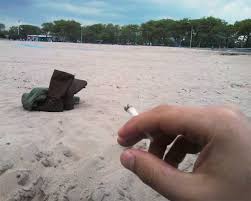
2. If #1 applies to you, covering your cigarette butt with two inches of sand is still littering.
3. The nearer they are to the ocean, the more some 7-year-old girls wish mermaids were real.

4. Because every wave is different, every wave needs jumping over.

5. Just because it says it's a "Dolphin Center," don't assume it has dolphins. You may, however, assume it has videos of dolphins. And if it's that kind of place, you should also know that "Suggested donation" is likely to mean "Mandatory entrance fee."

6. A mansion one block from the beach has nothing on a hovel directly on the beach.
7. The ten pounds I lost before this vacation have been picked up by other people. Several people, and several fold. I shouldn't be, but I am encouraged.
8. Boogie boarding counts as exercise. Especially on a red-flag day when the rip current is battering you like an egg in an omelette bowl.
9. A rip current is not the same thing as a rip tide.
10. It's a bad idea to take photos of your wife when she's boogie boarding and there's a rip current. Turns out the forces of nature propel wife one way, and her bikini bottoms another. Photographic confirmation of this phenomenon is scientifically relevant but maritally imprudent.
 (No, that's not my wife. I'm not stupid.)
1. If you want to smoke on the beach and bugger up the sea air don't do it near me and my kids. Especially when we got there first.
2. If #1 applies to you, covering your cigarette butt with two inches of sand is still littering.
3. The nearer they are to the ocean, the more some 7-year-old girls wish mermaids were real.

4. Because every wave is different, every wave needs jumping over.

5. Just because it says it's a "Dolphin Center," don't assume it has dolphins. You may, however, assume it has videos of dolphins. And if it's that kind of place, you should also know that "Suggested donation" is likely to mean "Mandatory entrance fee."
6. A mansion one block from the beach has nothing on a hovel directly on the beach.
7. The ten pounds I lost before this vacation have been picked up by other people. Several people, and several fold. I shouldn't be, but I am encouraged.
8. Boogie boarding counts as exercise. Especially on a red-flag day when the rip current is battering you like an egg in an omelette bowl.
9. A rip current is not the same thing as a rip tide.
10. It's a bad idea to take photos of your wife when she's boogie boarding and there's a rip current. Turns out the forces of nature propel wife one way, and her bikini bottoms another. Photographic confirmation of this phenomenon is scientifically relevant but maritally imprudent.
Tuesday, June 26, 2012
The mystery of the six-toed intruder
Everyone likes a good mystery, don't you think? Even if it can't be solved, there seems to be a certain pleasure in the wondering. Perhaps that's why Big Foot, aliens, and the Loch Ness Monster appeal - not because we expect to find them, but because we like to wonder, to consider the intriguing possibility that there are mysteries out there. . .
So here's one: yesterday morning I took the kids to summer camp. My littlest pointed out footprints on the windshield, prints that belonged to either a child or a 'little person.' Now, we have plenty of children in our neighborhood and no little people (that I've seen, anyway) but all three of mine denied knowledge of the print-leaver. They said they hadn't done it, and didn't know who had. And because of the way the conversation unfolded, I believed them.
And for another reason: none of my kids has six toes.
That's right. One of the prints very clearly left six toe smudges. I didn't spot this until I was driving but the kids will back me up. Six toes on one of the feet, the left I think.
So what happened, somehow, was that during the night a six-toed person with tiny feet crept into my closed and locked garage and climbed onto my car for no apparent reason.
Henry suggested maybe the intruder had five toes and one shifted a bit, leaving an impression of six, but such practical-minded nonsense was dismissed by me and my two girls.
After all, in a world needing intriguing mysteries, six toes will always be better than five.
So here's one: yesterday morning I took the kids to summer camp. My littlest pointed out footprints on the windshield, prints that belonged to either a child or a 'little person.' Now, we have plenty of children in our neighborhood and no little people (that I've seen, anyway) but all three of mine denied knowledge of the print-leaver. They said they hadn't done it, and didn't know who had. And because of the way the conversation unfolded, I believed them.
And for another reason: none of my kids has six toes.
That's right. One of the prints very clearly left six toe smudges. I didn't spot this until I was driving but the kids will back me up. Six toes on one of the feet, the left I think.
So what happened, somehow, was that during the night a six-toed person with tiny feet crept into my closed and locked garage and climbed onto my car for no apparent reason.
Henry suggested maybe the intruder had five toes and one shifted a bit, leaving an impression of six, but such practical-minded nonsense was dismissed by me and my two girls.
After all, in a world needing intriguing mysteries, six toes will always be better than five.
Subscribe to:
Posts (Atom)